


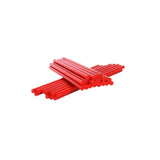

A good PDR rod set gives you three things: lengths that reach the dent from an existing opening, bends that get around braces, and tips that match the job, from sharp tips for small dents to round tips for soft pushes. Choose a PDR rod set by the dents you fix most, not by the piece count. This guide explains rod lengths and diameters, single, double and hook bends, sharp versus round tips, the 5/16 and M8 tip threads, and spring steel versus stainless, so you can tell what a set really covers before you buy it.
Key takeaways
- Pick rods by the access route: the rod must reach from the opening to the dent with room left for the handle. Longer is not automatically better.
- Thin shafts (5 to 6 mm) fit small holes and tight areas; 8 mm balances reach and strength; 10 to 12 mm shafts take heavy pushes with less flex.
- Single bends push straight up; double bends and hooks get the tip around braces, crash bars and edges.
- Interchangeable tips are threaded. US tools mostly use 5/16 coarse thread, many other makers use M8. Check before you mix brands.
- Hardness is one check, not the whole story. Well-made spring steel and AISI 630 stainless can feel the same; stainless needs no oiling.
What a PDR rod set should cover
A PDR rod set should cover the panels you work on most: short rods for door and fender holes, mid lengths for doors and quarter panels, long rods for hoods and roofs, and at least one bend that gets around a brace.
A rod is a steel shaft with a handle at one end and a tip at the other. You put it through an existing opening, find the dent's low spot from behind, and push the metal back in small, controlled steps while you read the reflection. Every choice in a set, the length, the diameter, the bend and the tip, decides where the tip can go and how it feels in your hand when you push.
Piece count tells you little. Ten rods in five sizes with mirrored left and right bends can cover more real dents than twenty straight rods in the same shape. Before you buy, read the size list, not the headline number.
Rod length and diameter: reach versus control
Choose length for the route and diameter for the force: a rod should be just long enough to reach the dent with the handle still in a stable spot, and thick enough not to flex under the push.
Super PDR's access planning guide puts it plainly: excess length is not automatically useful. A very long shaft sweeps a wider hidden area, flexes more under load and gives you less feedback, while a rod that is too short puts the handle inside the cavity or tempts you to use the opening as a hard lever.
| Shaft | Typical lengths | Best for |
|---|---|---|
| 5 to 6 mm | 20 to 50 cm | Small access holes, door and fender dings, tight areas behind trim |
| 8 mm | 50 to 70 cm | Doors, quarter panels, the everyday middle of a kit |
| 10 to 12 mm | 70 to 110 cm and more | Hoods, roofs, deep panels and heavy pushes where a thin rod would bow |
A thin, long rod is the combination that frustrates beginners: it reaches, but it bends before the metal moves. If you need reach and force together, go thicker.
Bends and hooks: single, double and special curves
A single bend pushes almost straight up from the shaft; a double bend steps the tip sideways so it can pass a brace; hooks and special curves wrap around crash bars, edges and inner fender liners.
- Single bend. The workhorse. Direct force transfer, easy to aim, ideal on open panel areas.
- Double bend. Two bends offset the tip, so the shaft can run along one side of a brace while the tip works the other side.
- Hooks, C-bends and question marks. They come back on themselves to reach around crash bars, door edges and fender liners.
- Left and right pairs. A mirrored set means you can reach the same dent from either side of an opening without working with your wrist twisted.
Many rods now have a 360-degree rotating handle. It lets you change and lock the grip angle without pulling the rod out of the access hole, which saves time and your wrist on long jobs.
Tips: sharp, round and interchangeable
Sharp tips put the push on a very small point for small dents and fine work; round and bead tips spread it out and avoid sharp tension marks on soft pushes and bigger lows.
A common pattern is round tips to move metal and sharp tips to finish. A whale tail is the flat cousin of a rod: its wide tip slides between a panel and a brace and spreads pressure across the dent, as we explain in our guide on how to learn PDR and the first tools to buy.
Interchangeable tip rods take screw-on tips. One thick rod plus a tip kit then works like several rods: a soft plastic tip to start a large low, a steel point to finish. The same tips often fit knockdowns and blending hammers too.
5/16 or M8: tip threads explained
Interchangeable PDR tips use one of two common threads: 5/16 inch coarse thread, the usual standard on US-made tools, or metric M8, common on tools from many other makers. They do not screw into each other.
3DPaintless notes that tools bought from US PDR companies most likely have a 5/16 coarse thread, while many foreign makers use 8 mm, and that tips sold online as 5/16 do not always fit. Car Cosmetics also names 5/16 UNC (5/16-18) as the industry standard for interchangeable tips.
- Check the thread of the tools you already own before you buy tips or a threaded rod.
- Stay with one thread across your rods, knockdowns and hammers where you can.
- If you have both, an adapter lets one tip set serve both threads.
Steel and hardness: spring steel versus stainless
A good rod resists taking a permanent bend, springs back predictably and feels the same as the other rods in its set; the steel and its heat treatment decide that more than any single number.
Super PDR's rod steel guide says hardness (HRC) is a useful indicator but not the whole story: extreme hardness without toughness makes a rod brittle, and heat treatment controls rebound and resistance to taking a set.
| Property | Spring steel | AISI 630 (17-4 PH) stainless |
|---|---|---|
| Hardness | Depends on the maker and heat treatment | Average 45 HRC on our rods |
| Feel and flex | Made for PDR hand tools | Made for PDR hand tools; precipitation-hardened, so it holds its bend under heavy pressure |
| Rust | Can surface-rust; wipe and protect with WD-40 or similar | High corrosion resistance; no oiling needed |
Note that "stainless" alone says little: AISI 630 is heat-treated for strength, while standard 430 ferritic stainless is a different, softer material. Ask which grade a rod is.
Building your PDR rod set: what to buy first
Start with mid-length rods in mirrored pairs and one thick rod with interchangeable tips, then add long roof rods and special hooks when real jobs ask for them.
From our catalog, three tools follow this order:
- Core set. The Kassel Edition 10-Piece 360° Rotating Modular PDR Rod Set has ten rods in five sizes, each with a mirrored right and left bend: 25 and 35 cm at 5 mm, 50 cm at 6 mm, and 60 and 70 cm at 8 mm, with a modular, detachable handle.
- Heavy push. The Xandora Edition Single Bend Interchangeable Tip PDR Rod has a 12 mm shaft in 50, 70, 90 or 110 cm, with a 5/16 or M8 tip thread.
- Tips. The DentPDR 12-Piece Stainless Steel Interchangeable Tip Set gives you twelve tip profiles for rods, knockdowns and hammers, in 5/16 or M8, with an adapter for the other thread.
The Kassel and Xandora rods are AISI 630 (17-4 PH) stainless, so they need no oiling. Every DentPDR tool is made in our own facility and comes with a 1-year warranty and a 30-day free exchange. You can pay via PayPal, which adds PayPal's 180-day buyer protection. For the next step, see how technicians plan a hail-damaged roof, where long rods earn their place.
Frequently asked questions
What size PDR rods do I need first?
For door dings and practice panels, rods from about 25 to 70 cm cover most work. Thin 5 to 6 mm shafts go through small holes; 8 mm rods handle doors and quarter panels. Add 90 cm and longer rods with thicker shafts when you start hoods, roofs and hail.
What is the difference between a single bend and a double bend PDR rod?
A single bend points the tip almost straight up from the shaft, which gives direct force on open panel areas. A double bend steps the tip sideways with two bends, so the shaft can pass along a brace while the tip works the dent behind it.
Are PDR tips 5/16 or M8?
Both exist. US-made PDR tools mostly use a 5/16 coarse thread (5/16-18 UNC), while many other makers use metric M8. The two do not fit each other. Check your tools before you buy tips, or use an adapter if you own both.
Is stainless steel better than spring steel for PDR rods?
Not stronger by default: a well heat-treated spring steel rod can flex the same way. Our rods are AISI 630 stainless at an average 45 HRC. The main difference is care. AISI 630 stainless resists rust and needs no oiling; spring steel should be wiped and protected with WD-40 or similar.
Do I need a 50-piece rod set to start PDR?
No. A set of mirrored mid-length rods, one thick rod with interchangeable tips and a few tips covers most small dents. Big sets make sense once your work includes hail, roofs and many panel types.


